Reading time:
How to build a personal financial timeline
Build a personal financial timeline from your bank transactions to clearly see how your money flows, spending patterns, and financial habits over time.

Article written by
Fausto Sánchez

How to Build a Personal Financial Timeline
Most people don’t have just one bank account.
You might have:
A primary bank account
A savings account
A credit card from another institution
An investment account
A digital wallet or fintech account
Each one lives in a different system.
Each one exports data in a different format.
Because of this, your financial history ends up fragmented across multiple institutions.
And that makes it surprisingly difficult to answer simple questions:
How much do I really spend each month?
How stable is my cash flow?
Where is my money actually going?
What will my finances look like in the future?
A personal financial timeline solves this problem by bringing all your financial activity into one single chronological history.
The Problem With Financial Data Today
Every financial institution structures transaction data differently.
Some banks export clean CSV files.
Others only provide PDFs.
Some categorize transactions automatically.
Others only give raw descriptions.
Even the same transaction can appear in multiple ways depending on the institution.
For example:
NETFLIX.COM 3849203
Netflix Subscription
POS PURCHASE NETFLIX
All represent the exact same purchase.
Without cleaning and consolidating the data, building a full financial picture becomes difficult.
That’s why creating a unified financial timeline is so valuable.
Step 1 — Collect Data From All Your Financial Accounts
Start by exporting transactions from every institution you use.
This typically includes:
Bank accounts
Credit cards
Investment platforms
Fintech apps
Digital wallets
Most platforms allow exporting transactions as CSV files.
Typical fields include:
Date
Description
Amount
Balance (sometimes)
Each export represents a piece of your financial history.
Step 2 — Upload Your Statements to Ploisy
Once you have your bank statements, upload them into Ploisy.
Ploisy’s bank statement importer is designed to handle messy financial data from different institutions.
It helps you:
Import bank statements in various formats
Automatically detect transaction columns
Normalize inconsistent formats
Combine data from multiple financial institutions
Instead of manually cleaning spreadsheets, Ploisy does the heavy lifting for you.
Within seconds, your fragmented financial data becomes a single unified dataset.
Step 3 — Analyze Your Complete Financial Timeline
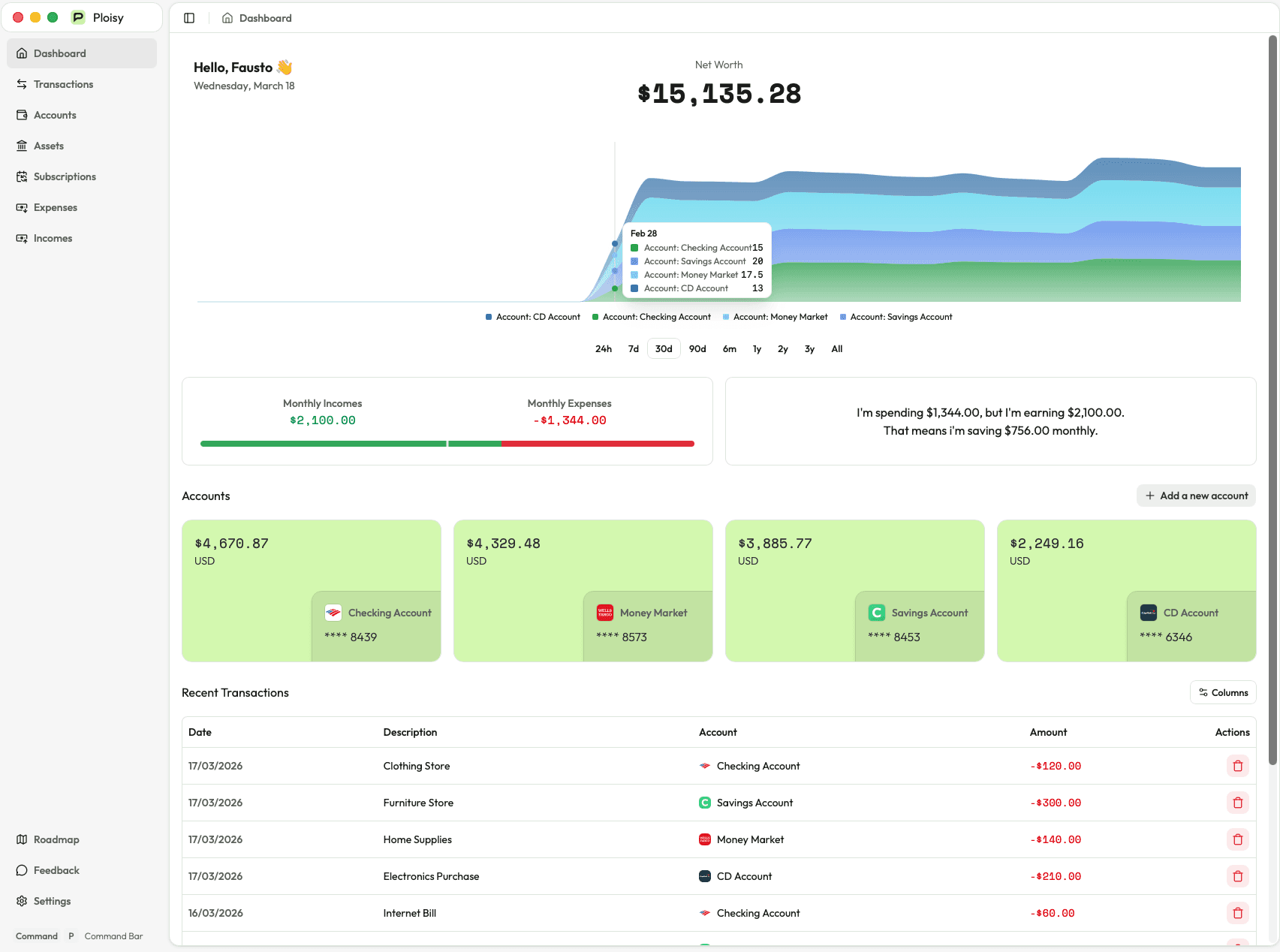
Once your data is imported, Ploisy builds a clear financial timeline across all your accounts.
Instead of separate bank statements, you now see one continuous flow of financial activity.
This makes it much easier to understand:
Your real monthly spending
Income patterns
Recurring subscriptions
Cash flow trends
Financial behavior over time
For example:
Jan 3 — Salary +$3,200
Jan 5 — Rent −$1,100
Jan 7 — Groceries −$95
Jan 10 — Netflix −$15
When everything is combined into one timeline, patterns become obvious.
Why a Financial Timeline Matters
Your finances don’t exist in isolated bank accounts.
They exist as a single financial system across multiple institutions.
By building a financial timeline you can:
Understand where your money actually goes
Identify spending patterns
Detect recurring expenses
Project future cash flow
Make better financial decisions
What was previously scattered across different banks becomes one clear story.
Final Thoughts
Your financial data already exists.
The challenge is that it’s spread across multiple institutions and formats.
By collecting your bank statements and importing them into Ploisy, you can transform fragmented financial data into a clear financial timeline.
And once you can see the full picture, planning your financial future becomes much easier.
If you want early access:
Article written by
Fausto Sánchez