Reading time:
What a modern personal finance tool should look like
Import data from any bank, unify every account, and instantly see your real financial story. That’s what modern personal finance should feel like.

Article written by
Fausto Sánchez

What a modern personal finance tool should look like
For most people, managing personal finances is more fragmented than ever.
A few years ago it was common to have a single bank account and maybe one credit card. Today the situation is very different. You might have a checking account in one bank, savings in another, a credit card issued by a different institution, an investment account somewhere else, and possibly a couple of digital wallets or fintech apps.
Each platform shows your data in its own way.
Each one exports information in a different format.
Each one gives you only a partial view of your financial life.
As a result, your financial story ends up scattered across multiple systems.
You can see your balance in one place.
Your credit card transactions in another.
Your savings somewhere else.
But rarely can you see everything together.
And without that full picture, it becomes very difficult to understand what is actually happening with your money over time.
The real problem: fragmented financial data
Most financial institutions are built to manage accounts, not to help you understand your entire financial life.
They show transactions related to their own products, but they have no visibility into the rest of your finances.
If you want to understand things like:
How your spending evolved over the last 12 months
How much you actually save every month
Where most of your money goes
How your financial position changes over time
you usually have to manually combine data from multiple sources.
That often means exporting files, cleaning spreadsheets, and trying to maintain a system that quickly becomes too time-consuming to keep updated.
Over time, most people simply stop doing it.
What a modern personal finance tool should do
A modern personal finance tool should focus on one core idea:
Your financial data should live in one place.
Instead of being limited to one bank or relying on fragile integrations that may not work in every country, the system should allow you to bring your financial history together in a flexible way.
The goal is not just to store transactions.
The goal is to build a complete financial timeline.
When all your financial activity lives in one place, you can finally see patterns that were previously hidden. Spending habits become clear. Trends appear. You can start understanding how your finances evolve month after month and year after year.
That visibility is the foundation for making better decisions.
Your financial history is more important than your current balance
Many banking apps focus heavily on the current balance of an account.
But your current balance is just a snapshot.
What really matters is your financial history.
Your financial history tells the story of how your money moves:
How much you earn
How much you spend
What categories consume most of your income
How your savings evolve over time
Without historical data, it is almost impossible to analyze trends or make projections about the future.
A modern finance tool should help you build and maintain that history.
A simple approach: bring your data together
Instead of trying to reinvent banking, the simplest solution is often the most effective.
Just bring your financial data together.
Most banks already allow you to export your transactions as CSV or spreadsheet files. Those files contain everything needed to reconstruct your financial activity.
Once imported into a single system, they become the building blocks of your financial history.
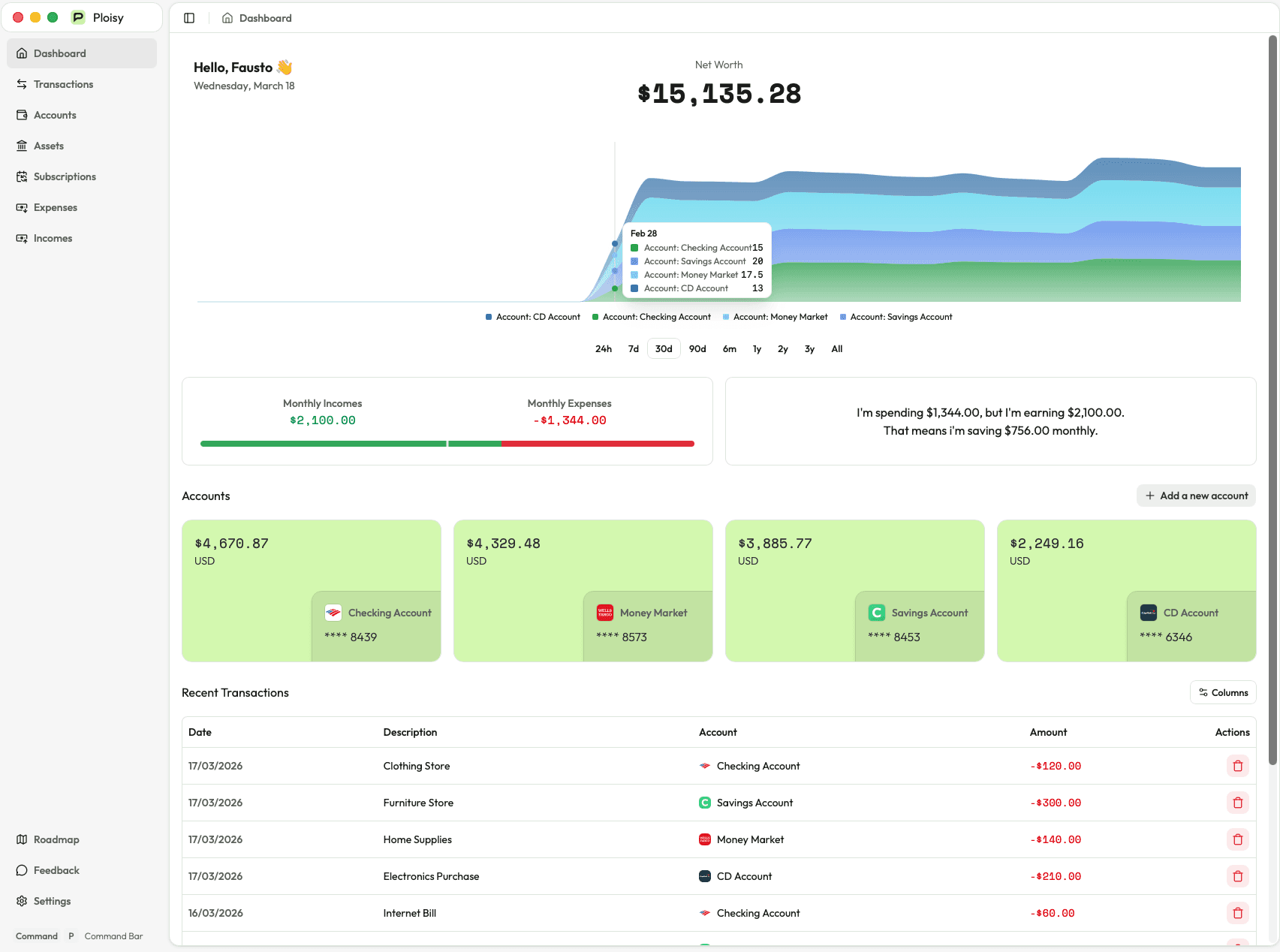
This is exactly the approach used by Ploisy.
The process is simple
Step 1: Collect your financial data
Download transaction files from the banks or financial institutions you use. Most platforms allow exporting transactions as CSV or spreadsheet files.
Step 2: Upload them to Ploisy
Ploisy’s bank statement importer reads those files and converts them into structured transactions, even if the formats differ between banks.
Step 3: Analyze your finances
Once your data is imported, your financial history becomes easy to explore. You can review transactions, identify patterns, and better understand how your money moves over time.
Financial clarity should not depend on your bank
Your financial life rarely exists inside a single institution.
And yet most tools are designed as if it did.
A modern personal finance tool should recognize that reality and focus on helping you build a complete picture of your finances, independent of any specific bank.
Your data should belong to you.
And the tools you use should help you understand it.
Article written by
Fausto Sánchez